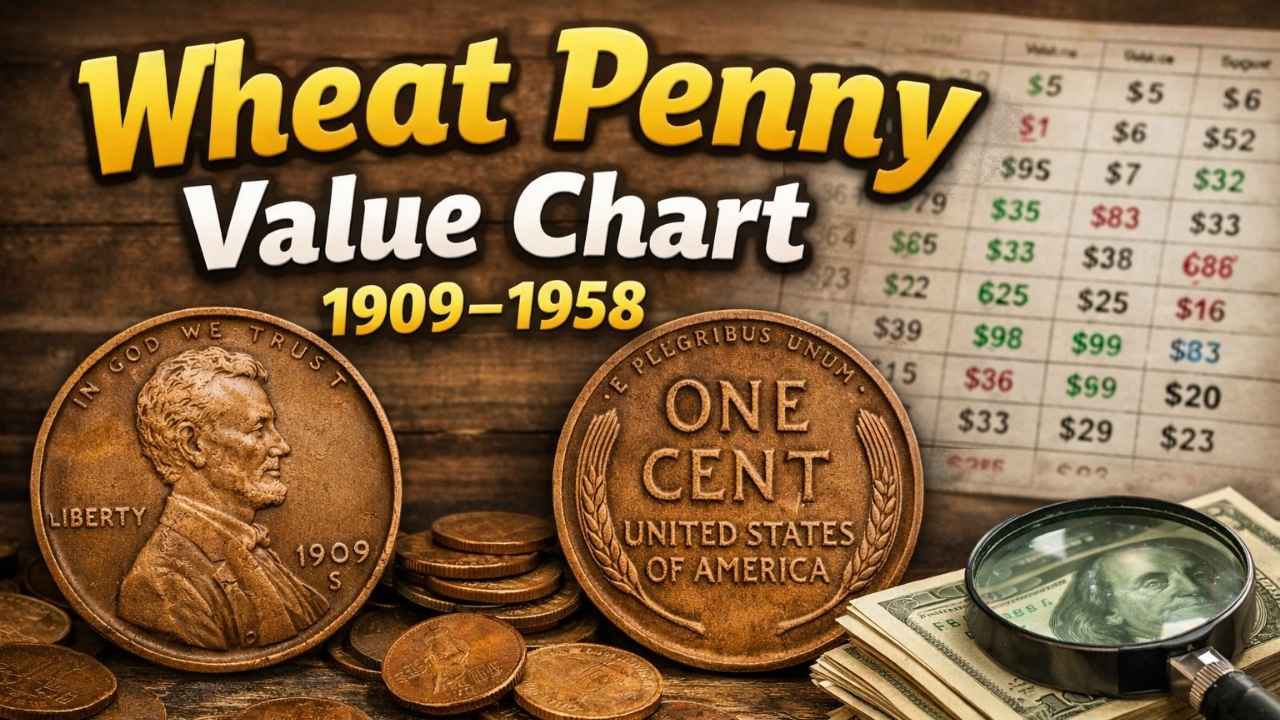
Wheat Penny Value Chart 1909–1958: The Wheat Penny, first introduced in 1909, is one of the most beloved coins in American history. Featuring President Abraham Lincoln on the obverse and two stalks of wheat on the reverse, this coin is a significant part of the nation’s numismatic legacy. The Wheat Penny was in circulation for nearly 50 years before it was replaced by the Lincoln Memorial design in 1959. Over the decades, certain Wheat Pennies have become highly collectible and valuable due to their rarity, minting errors, or historical significance. In this guide, we’ll explore the value of Wheat Pennies from 1909 to 1958, providing a complete price chart for collectors to reference.
The History Behind the Wheat Penny
The Wheat Penny was introduced in 1909 to honor the 100th anniversary of Abraham Lincoln’s birth. The coin was designed by Victor David Brenner, who crafted the famous portrait of Lincoln on the obverse. The reverse side featured two stalks of wheat, a design that became iconic in American coinage. The Wheat Penny remained in production until 1958, after which the reverse design was changed to the Lincoln Memorial to celebrate the 150th anniversary of Lincoln’s birth.
Throughout its production run, the Wheat Penny underwent a few minor design changes, but its basic structure remained largely the same. It was originally composed of 95% copper and 5% tin and zinc, giving it a distinct reddish-brown color that is still characteristic of the coin today. Although most Wheat Pennies are not worth much more than their face value, certain years, mint marks, and conditions can significantly increase their value.
Factors That Determine the Value of Wheat Pennies
The value of a Wheat Penny depends on several key factors that collectors should consider when evaluating a coin. These factors include:

Year of Minting
Certain years are rarer than others, making them more valuable to collectors. Pennies minted in limited quantities or during specific years of historical importance tend to fetch higher prices. For example, the 1909-S VDB and the 1922 No D are two highly sought-after Wheat Pennies due to their rarity.
Mint Mark
The mint mark on a coin indicates where it was produced. For Wheat Pennies, the common mint marks are “D” for Denver, “S” for San Francisco, and no mint mark for Philadelphia. Some mint marks are rarer than others, which can increase the coin’s value. For instance, coins minted in San Francisco during certain years can be significantly more valuable than those minted in Philadelphia.
Condition and Grading
A coin’s condition plays a crucial role in determining its value. Coins that are in excellent condition, free from wear, scratches, or discoloration, are considered “uncirculated” and are worth more. Coins are graded on a scale from 1 to 70, with 70 being perfect. The higher the grade, the more valuable the coin. For example, an uncirculated 1909-S VDB penny in MS65 condition can be worth thousands of dollars, while a heavily worn example from the same year may only be worth a fraction of that amount.
Special Features or Errors
Wheat Pennies with minting errors, such as double strikes, off-center designs, or missing mint marks, can be particularly valuable. These error coins are often rare and highly prized by collectors. For example, the 1922 No D Wheat Penny is one of the most famous error coins, where the “D” mint mark was mistakenly left off.

Wheat Penny Value Chart: 1909–1958
Now that we have an understanding of the factors that determine the value of Wheat Pennies, let’s explore the value chart for Wheat Pennies minted between 1909 and 1958. The values listed below are for coins in average circulated condition. Keep in mind that coins in uncirculated or high-grade condition can be worth much more.
1909
- Value (Average Circulated): $0.50 to $2.00
- Key Date: 1909-S VDB (worth $800 to $1,500 in average circulated condition)
The 1909-S VDB is one of the most famous and valuable Wheat Pennies due to its low mintage and the designer’s initials on the reverse. Coins in good condition are worth several hundred dollars, and high-grade specimens can fetch thousands.
1910
- Value (Average Circulated): $0.10 to $0.30
- Key Date: None
While the 1910 Wheat Penny is not a key date, it is still a popular coin among collectors. Coins in excellent condition can fetch higher prices, but they are generally not worth as much as other key dates.
1911
- Value (Average Circulated): $0.10 to $0.30
- Key Date: None
Similar to the 1910 penny, the 1911 Wheat Penny is not considered rare, but it remains a collectible coin for those interested in completing their set of Wheat Pennies.
1914
- Value (Average Circulated): $0.50 to $1.00
- Key Date: 1914-D (worth $50 to $100 in average circulated condition)
The 1914-D Wheat Penny is a key date due to its low mintage. In uncirculated condition, this coin can be worth several hundred dollars, making it one of the more valuable pennies from this period.
1922
- Value (Average Circulated): $0.10 to $0.50
- Key Date: 1922 No D (worth $1,000 to $5,000 in average circulated condition)
The 1922 No D is one of the most famous error coins in the Wheat Penny series. Due to a minting mistake, the “D” mint mark was omitted from some coins. These error pennies can be worth thousands of dollars in good condition.

1931-S
- Value (Average Circulated): $1.00 to $3.00
- Key Date: Yes
The 1931-S Wheat Penny has a low mintage, making it a sought-after coin. While not as valuable as some of the more famous key dates, it is still worth significantly more than most other Wheat Pennies from this period.
1943
- Value (Average Circulated): $0.10 to $0.50
- Key Date: 1943 Copper (worth $200,000 to $500,000 in excellent condition)
The 1943 Wheat Penny is famous for being struck in steel instead of copper due to wartime material shortages. However, a few copper versions were accidentally minted, and these rare coins can be worth hundreds of thousands of dollars.
1944
- Value (Average Circulated): $0.05 to $0.25
- Key Date: 1944 Steel (worth $100 to $500 in excellent condition)
The 1944 Steel Wheat Penny is another error coin. It was struck mistakenly in steel instead of copper, making it a valuable find for collectors.
1955
- Value (Average Circulated): $0.10 to $0.50
- Key Date: 1955 Double Die Obverse (worth $500 to $1,000 in excellent condition)
The 1955 Double Die Obverse is one of the most famous error coins in the Wheat Penny series. The doubling of the inscriptions “LIBERTY” and “IN GOD WE TRUST” makes this coin highly sought after.
1958
- Value (Average Circulated): $0.05 to $0.25
- Key Date: None
The final year of the Wheat Penny series, the 1958 coin is the most common of the series. Although it is not a key date, it is still an important coin in completing a Wheat Penny collection.
Conclusion: Wheat Pennies as a Collector’s Investment
Wheat Pennies are more than just a piece of American history—they are a valuable and sought-after collectible for numismatists. While most Wheat Pennies are worth only a few cents over their face value, certain key dates and minting errors can make these coins worth significant sums. Understanding the value chart for Wheat Pennies from 1909 to 1958 will help collectors identify the most valuable coins in their collection and make informed decisions when buying or selling these iconic coins. Whether you’re just beginning your collection or you’re a seasoned numismatist, the Wheat Penny remains a timeless treasure in the world of coin collecting.