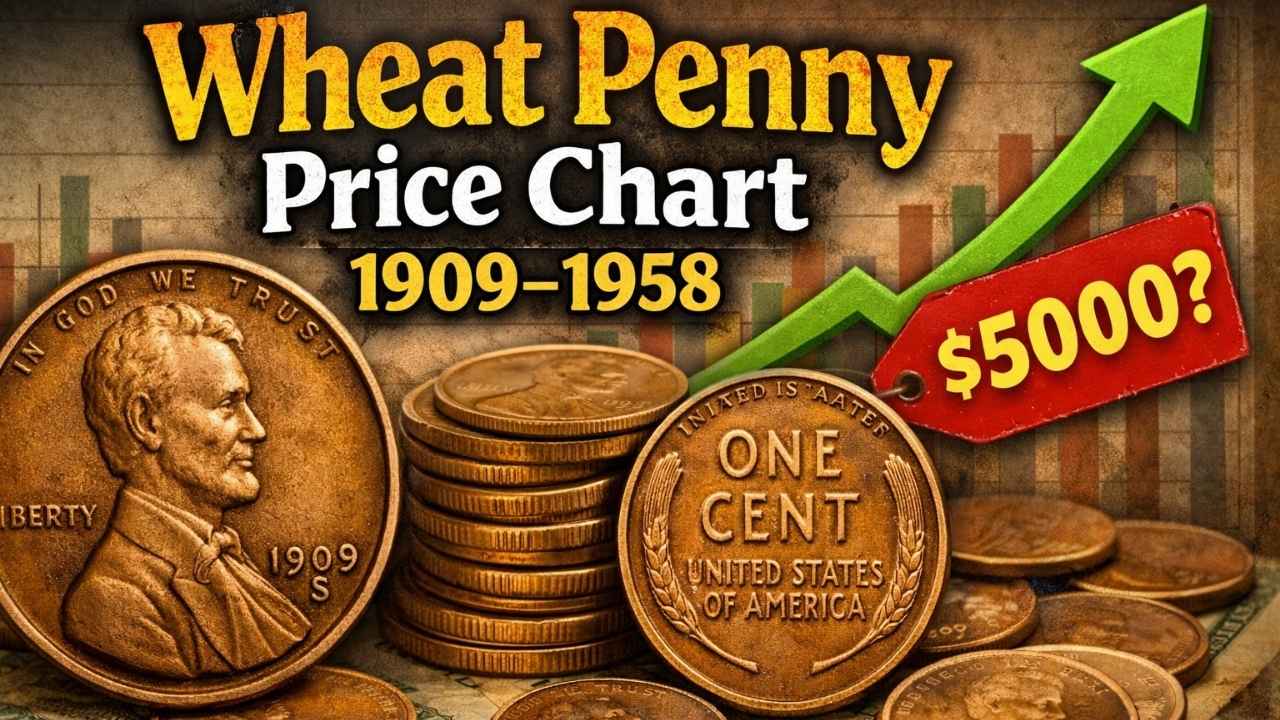
Wheat Penny Price Chart 1909–1958: The Lincoln Wheat Penny is more than just a coin. It is a piece of American history that spans fifty years, from 1909 until 1958. Collectors admire it for its design, its connection to Abraham Lincoln, and the thrill of hunting down rare dates and mint marks. This guide presents a year‑by‑year chart of values, helping both beginners and seasoned numismatists understand what their coins may be worth.
How Values Are Determined
Coin values depend on condition, rarity, and demand. A heavily worn penny may only be worth a few cents, while a pristine uncirculated example could sell for hundreds. Mint marks add another layer of interest. Philadelphia coins carry no mark, Denver coins show a D, and San Francisco coins show an S. Lower mintages often mean higher values.
1909 to 1919
- 1909 VDB: Circulated $10 to $25, Uncirculated $50+
- 1909 S VDB: Circulated $600+, Uncirculated $2000+
- 1914 D: Circulated $150+, Uncirculated $1000+
- 1917 and 1918 common dates: Circulated $0.50 to $2, Uncirculated $20+
These early years contain some of the most famous rarities. The 1909 S VDB is the crown jewel, while the 1914 D is another key date.
1920 to 1929
- 1922 no D: Circulated $500+, Uncirculated $2000+
- 1924 D: Circulated $30+, Uncirculated $200+
- 1926 S: Circulated $20+, Uncirculated $150+
- Common 1920s dates: Circulated $0.25 to $1, Uncirculated $10+
The 1922 no D variety is legendary, created when the Denver Mint produced coins without a visible mint mark.
1930 to 1939
- 1931 S: Circulated $40+, Uncirculated $150+
- Other 1930s dates: Circulated $0.10 to $0.50, Uncirculated $5 to $15
The 1931 S is the standout of the decade, with low mintage making it scarce.
1940 to 1949
- 1943 steel cents: Circulated $0.25 to $1, Uncirculated $5+
- 1943 copper penny: Extremely rare, values $50,000+
- Other 1940s dates: Circulated $0.05 to $0.25, Uncirculated $2 to $10
World War II brought the famous steel cents. The rare copper 1943 penny is one of the most valuable coins in American history.
1950 to 1958
- 1955 doubled die obverse: Circulated $1000+, Uncirculated $5000+
- Common 1950s dates: Circulated $0.05 to $0.20, Uncirculated $1 to $5
The doubled die of 1955 is the star of the final decade, with dramatic doubling visible on the date and lettering.
Collector Tips
- Start with affordable coins from the 1940s and 1950s.
- Gradually add scarcer dates like the 1924 D or 1931 S.
- Protect coins in holders to prevent damage.
- Consider professional grading for rare pieces.
Conclusion
The Wheat Penny series offers something for everyone. Beginners can enjoy building sets of common coins, while advanced collectors can chase legendary rarities like the 1909 S VDB or the 1955 doubled die. With patience and knowledge, assembling a complete collection becomes a rewarding journey through American history.